
Writing Sideways
The cage and the bird

Perhaps the thing I love most about narrative is its ability to deliver me to a completely unexpected place. I experience those moments in fiction powerfully, even physically. I think because I am constantly trying to predict where the story is going that when a story is able to deliver a completely unanticipated landing, I experience something like a combination of elation and relief. I feel that I look up from the page and the world is fundamentally altered.
I think this happens when the writer has written themselves to a place of new knowledge. Has, in the process of writing, written through everything they already knew and discovered something they did not know before. It’s that sense of excitement and discovery that I think accounts for those moments in fiction that feel that something has been tipped on its head. The writer has, in other words uncovered a secret — maybe not a secret for the world, but something that was until it was written, secret or hidden to them.
To a certain extent, all good storytelling depends upon a secret. Uncovering the unexpected, which I am going to call writing sideways, involves the excitement of putting something that perhaps the writer has been aware of, but is now finally able to articulate in words. It’s perhaps the relief of turning that dark, inchoate knowledge into something concrete in the form of words.
Sometimes secrets in novels are never revealed, only gestured towards or unspoken in some crucial way. In some novels, the characters are pointedly stepping around a secret in a way that shows the reader what that secret is, without ever actually naming it. Of course in any story there is always the ongoing secret of “What’s going to happen next?” But although keeping readers interested in that basic question is important, the type of secrets I am talking about here are more substantial than that. They’re secrets of being, of what makes a character, or a society, or a family who or what they are. They reveal the unspoken essence of something. I think my favourite novels always contain secrets that are never answered directly and are built around that mystery.
One of my favourite quotes on this comes from Franz Kafka, who is quoted as saying that the definition of a story is: “A cage went in search of a bird.” I think this is possibly the most apt description of a story I have ever read, in the sense that in any good work of fiction you have the literal story (the cage) and the thing that you are trying to convey with that story (the bird). The bird itself may never be described, because in any good story, or perhaps only great ones, it is the reader who supplies the bird, and they take it with them when they leave.
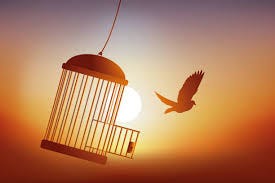
The cage in this metaphor is the literal story: the characters, the events. The bird is that elusive thing: the meaning, the insight, the new knowledge that this story has, by circling around a truth, by approaching it sideways, captured. It is the thing that can only be captured by putting these characters and these events together on the page, through this particular arrangement of language. As Catherine Brady puts it,
“Every good story seeks to impose form on what cannot finally be grasped by form — to prove the elusiveness of meaning through the exacting effort to capture it.”
That is why fiction can have such powerful effects: because it can say something without actually saying it. Or to put this another way: the thing that is being said is resistant to literal expression, and yet, narrative and language put together in the particular arrangement of this story somehow manages to name it. This is why story has the power to say the unsayable, and why the reader is always the co-creator in any sort of storytelling par-excellence. They’ve been let in on a secret that can only be attained by investing themselves in these characters, in this plot.
One of the first times I had this sense of a narrative swerving to a completely unexpected place was in Anne Enright’s short story ‘Natalie’, which I first read in the New Yorker and later in her excellent short story collection Taking Pictures. In fact, I think that story taught me what a narrative was. At the time I read it I was trying to write the short stories that would become my first collection, Having Cried Wolf, and after I read the story I suddenly understood how you could have a piece of writing that involved characters and plot that led to a conclusion, but that did not necessarily result in a story.
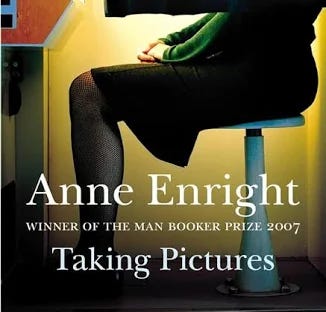
In ‘Natalie’, an adolescent girl reflects on her friendship with Natalie. The story is a framed narrative, in the sense that the narrator wakes up in the middle of the night following a phone conversation with Natalie earlier that day. The narrator spends the story puzzling over what it was that woke her up — for the duration of the story she remains in bed. Natalie is the friend that appears perfect, and to have everything together and figured out,
“Natalie should be a star. When she grows up, that is, Natalie should be something really impressive. Because if she isn’t then it’ll get pretty lonely won’t it?”
The whole story involves this unnamed narrator putting the sequence of events together leading up to the debutante’s ball. Natalie has a boyfriend Billy, whose mother is suffering from ovarian cancer and is going through chemotherapy and she’s “a bit of a bitch too”: threatening to leave Billy’s father when she’s through the treatment, because the steroids she’s given make her feel invincible. It’s Billy’s mother that the narrator identifies most strongly with. The narrator also has a boyfriend, who is unnamed, and who she also professes to love, although later decides it isn’t love but a “stupid kind of bliss”.
Though as the story opens, we get the very strong sense that the narrator aspires to be like Natalie — glamorous and attractive, as the story goes on and as the narrator slowly pieces things together, she comes to understand things differently. That Natalie aspires to a conventional, hetero-normative life that involves simply mirroring what she sees around her. She has not done the work of discovering who she really is, or what she wants from life. Maybe she doesn’t even care about those things. And the narrator starts to realise that despite her attractiveness, and her clear vision for her life, Natalie is ultimately quite superficial.
And as the narrator lies there in her bed, allowing “the little moments to fly around my head”, the narrator’s understanding of her experience shifts. The conclusion of the story comes with the recognition of what woke her up: “a feeling like a horror film — except really boring”. Enright writes,
“It was the sheets. When I lay down, just for a second on Mr and Mrs Casey’s moss-green sheets. Before the dance, when I was all dolled up in my silk skirt, and I pushed my hands along them and put my cheek against the dark cotton, just for a second. It was the smell of those sheets — cool, unwashed; like something I really wanted, going stale.”
What is unspoken is this: in fact, she doesn’t want what Natalie wants: the nail-polish, the silk-dresses, the glamour. This young woman, on the verge of adulthood is realising that the things she thought wanted aren’t really worth wanting at all. That a conventional life, marriage, even normativity, although she has been playing at them, aren’t what she wants and hence the smell of the sheets that represent all of that going stale.
Except none of that is ever actually spoken. When I first read the story, I wouldn’t have been able to articulate what that change was. Except I felt it and I knew exactly what she meant. That is the beauty of writing sideways, it requires the reader to supply the meaning. But more than that, it gives the reader the experience of vicariously feeling this momentous revelation and transformation that this young woman is going through. This is the bird of Anne Enright’s story, contained in the literal story of a young woman waking up at night and reflecting on her relationship with Natalie.

To answer a metaphor with another metaphor, this type of writing reminds me of the advice I was given as a child when Halley’s Comet last visited our solar system. Woken as I was in the middle of the night by my parents, during a prime viewing window, I remember the advice: the comet is easier to see if you don’t look directly at it. Look to the side of it, with the corner of your eye. And sure enough, there it was, that distinct trail of indistinct light hurtling through the sky. Bluish silver. Flickering. Almost alive.
Excellent story-telling almost always feels like that — by not approach something directly, by stepping towards it sideways writers can give us a glimpse of something otherwise unfathomable. Something that cannot be viewed in any other way and to say it in literal words would be to reduce it. Writing sideways makes the invisible visible. Like viewing Halley’s comet from the corner of one’s eye, writing sideways gives us a glimpse of something fleeting and magnificent.
The exercise
A character approaches a well; a building; a lake and glimpse something inside. What’s there changes them forever. Write this sequence without revealing the thing that the character sees.
Reflection
Allowing a secret to exist between reader and author involves the greatest act of trust. The writer is saying to the reader, I trust you to know what I’m talking about here. I trust your mind, your imagination, your experience. The ultimate meaning rests with you. That trust is often the thing that distinguishes great stories from average ones. So approach it sideways, as though it is an easily startled bird.