
Escalate or die
On making your reader actually care

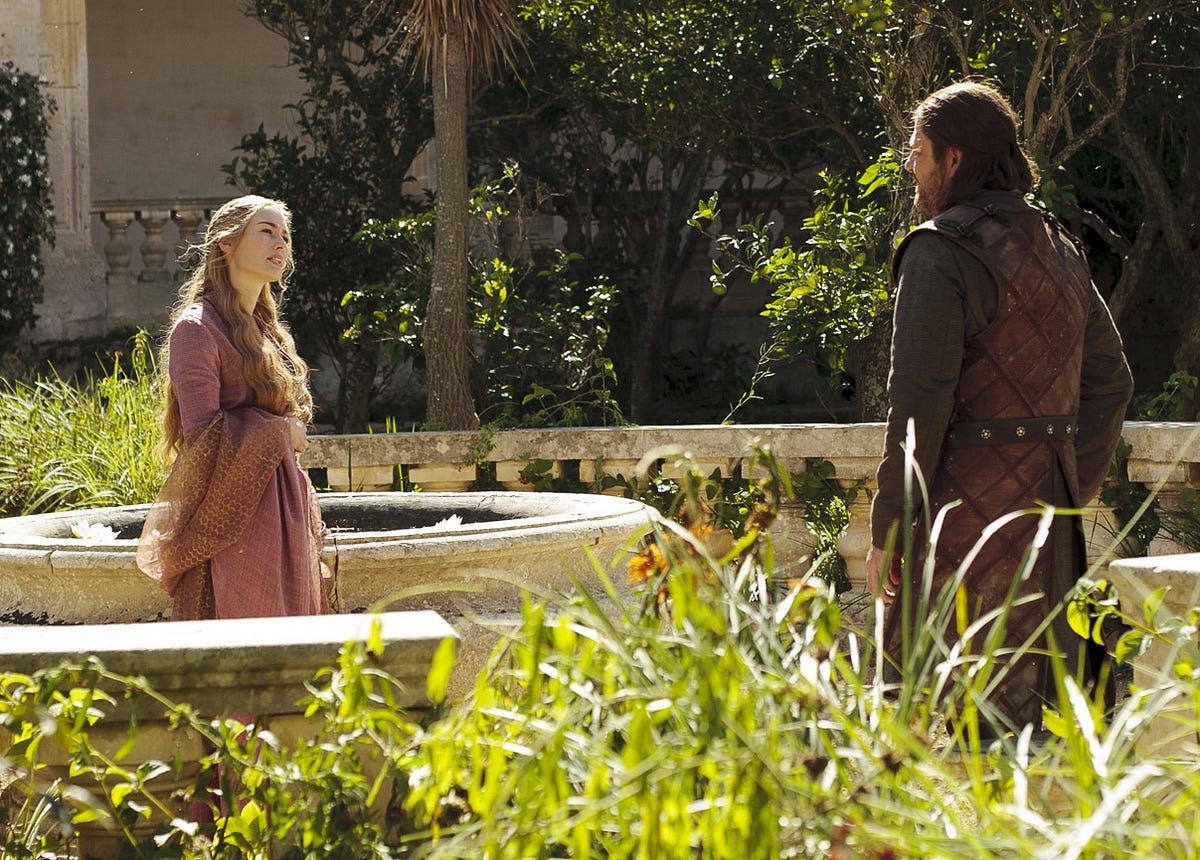
One of my favourite pieces of dialogue from the HBO remake of GRRM’s Game of Thrones is the conversation between Cersei Lanister and Ned Stark, where Cersei says,
‘When you play the game of thrones, either you win or you do. There is no middle ground.’
It’s such an excellent line because not only does it starkly characterise the circumstances Ned finds himself in, this statement comes to be characteristic of practically every conflict in the whole series. And it’s the life or death consequences that keeps us glued to the screen. Although it’s not always a literal death, we know from those first moments of the show that if a character doesn’t prevail, the consequences will be severe. And that is electric to watch because that potential is latent in every scene.
Hence the inspiration for today’s title, because in fiction that is the essential choice you have in keeping your reader engaged. Either you escalate, or your book dies in your reader’s hands.
Although it might initially seem that escalation is most important for a particular type of novel that relies on propulsion, such as the thriller or crime novel, in fact escalation is important to every writer, because it’s really just a form of making your reader care. Of investing themselves more in the story you are telling.
Escalation sounds like an extremely technical thing, but in fact, escalation is simple. Escalation is always tethered to change. It involves either: a change to the status quo. Or a change in the way your character relates to the status quo. In fact, all narrative is built on the chassis of change, but escalation involves a particular type of change: change that is meaningful and consequential for your character.
What is change? Change is disruption. Change is shift. Change is variation. And in fact, it doesn’t even have to be a huge shift. Certainly, a person dying is a change, but so is a person failing to show up for an appointment. In fact, it’s possible for a minor change to be hugely consequential and meaningful for your character in a way that more apparently momentous change is not. In fact, sometimes when I read a crime novel, I find myself saying internally, so another person died, but do I really care?
That is because a death is not really a death in fiction, but an event, a device. If the death involves a character we know and relate to then yes it may be extremely meaningful and consequential. But in many crime novels a death is simply a puzzle to be solved: in fact, if it were more than that, if we really did attribute the emotional consequence of an actual death to a death in a novel, we might actually find it difficult to continue reading. Death in life has a way of bringing life to a halt. Death in fiction, if done well, has a way of propelling it forward.
Here is an interesting fact about making your reader care more: your reader will care much more about a character who fails rather than succeeds. A reader will care more about a character who is laid off from their job than a character who lands their dream-job. A reader will care much more about a character who has loved denied to them, than they will about a character who has lovers throwing themselves at their feet. Success is fundamentally boring in fiction. Though counter-intuitive this is for two reasons: because it’s through our fragility, or losses, that we connect and identify more with others. Also, perfect characters, just like people without flaws, simply are not real. They do not, in my experience, exist. Anyone who seems to be always perfect, always succeeding, I would like to suggest is probably extremely broken inside. And it’s that brokenness that is the stuff of excellent fiction.
The most interesting people, the most enlightened and engaging of us are those who have confronted failure and loss but who still, somehow, manage to continue to show up and persevere. And this tells us something about the sort of change needed for escalation. It is change that is consequential at an existential level for a character, change that once they confront it, has the potential to reveal who they are. Perhaps it’s not life or death, but it is often a question of whether to exist fully in the world, or not.
Perhaps the best way I can illustrate change as escalation is by reference to a concrete example. And one short story I always use to teach escalation is Shirley Jackson’s very short but utterly heart-stopping, The Lottery. There’s a reason it’s one of the most anthologised short stories of all time. Here is a brief overview: in a small, unnamed town of slightly more than 300 people, a lottery is being conducted. Although lotteries like these are conducted everywhere, we slowly learn that this is not the sort of lottery in which people win money, but a lottery in which one person will die, though to be fair this is only completely clear in the story’s closing sentence. By the way, you can listen to the story being read here by A.M. Homes: https://www.newyorker.com/podcast/the-authors-voice/a-m-homes-reads-shirley-jackson-the-lottery

By my calculation, Jackson uses three moments of escalation in this story of just over 3,000 words. The story opens very hopefully, like this:
“The morning of June 27th was clear and sunny, with the fresh warmth of a full-summer day; the flowers were blossoming profusely and the grass was richly green.”
It’s sunny! The flowers aren’t just blossoming, they’re blossoming profusely! The grass is abundant! What could possibly go wrong? The first escalation comes in the following unsettling sentence:
“Bobby Martin had already stuffed his pockets full of stones, and other boys soon followed his example, selecting the smoothest and roundest stones.”
The stones suddenly upset the dynamic here. Although it is summer. Although the flowers are blossoming profusely, Bobby Martin and his friends are gathering a pile of stones. It’s that moment in reading when the dread suddenly appears. It’s not overwhelming at first, it’s just unsettling feeling that this is not what we expected it to be. And it’s done so simply, with the introduction of actual stones.
But then the story continues happily on its way, families mingle and we are given an explanation of some of the procedural aspects of the lottery. We learn that Mr Summers, who also conducts the square dances, the teen-age club and the Halloween program, runs the lottery, since he is retired and has “the time and energy to devote to civic activities.” We learn about the “black box” used to conduct the lottery, a replacement since “the original paraphernalia had been lost long ago.” What is happening here is a period of stabilisation. We’re being allowed to get comfortable with the situation. Maybe, we’re allowed to think, things aren’t so bad after all?
Lord Saunders says this is what a story does: after a period of escalation it flattens out, until the next moment of change:
“The whole experience of reading fiction might be understood as a series of “establishings” (“the dog is sleeping”), stabilizations (“he is really sleeping deeply, so deeply that the cat just managed to walk across his back”), and alterations (“Uh-oh, he woke up.”
The next moment of escalation is the arrival of Mrs Hutchinson, whose name we later learn is Tessie. Mrs Hutchinson is depicted differently to the other villagers in that she is humanised. She’s late to the lottery because she, “Clean forgot what day it was” and was standing at the sink washing up. She is the first character to be personalised in this way, and she makes banter with the other village folk. Mr Summers jokes that he thought he would have to start without her and Mrs Hutchinson obliges by returning that she couldn’t leave her dishes in the sink. Soft laughter ripples through the crowd. This is an escalation because Mrs Hutchinson is suddenly a living, breathing vulnerable person and of course, she is significant to the story’s ultimate conclusion.
Then the story stabilises again, as the procedure of the lottery is underway. It almost, but not quite, becomes boring in its procedural unfoldings. One by one the men take a folded piece of paper out of the box for their families. Someone mentions that in the north village, they’re talking of giving up the lottery, to which Old Man Warner snorts and says,
“Pack of crazy fools…Next thing you know, they’ll be wanting to go back to living in caves.”
Though this is the abiding question of the story, the why of the lottery is never explained which makes the whole thing particularly sinister.
The third escalation is that, of course, Bill Hutchinson takes the piece of paper that is marked and of course Tessie protests that the selection wasn’t fair. Her husband tells her to shut up. This is an escalation, because now we know the family are marked. The lottery is narrowing and the result is approaching. It’s a change in odds — someone in the Hutchinson family will be selected. And then a new procedure gets underway as family members start drawing slips of paper.
Of course it is Tessie Hutchinson who draws the paper with the black spot on it and the story moves rapidly to its horrifying conclusion. In an act of either malice or mercy, Mrs Delacroix selects such a large stone she has to lift with both of her hands. And then that cracking final line, “then they were upon her.”
*
To recap, the story contains precisely three escalations, set at roughly equal intervals:
1. Bobby Martin picks up a stone.
2. Tessie Hutchinson arrives late.
3. Bill Hutchinson selects the marked piece of paper.
That’s it. It’s all so simply but effective it could be plotted on a graph.
There are a few remarks that can be made about Jackson’s brilliant escalations here. The first is how simply they are effected: the simplicity of the stones in that first escalation, made even more poignant by the way that the village boys are excitedly collecting a pile of stones, as boys are wont to do. The way Tessie Hutchinson is very clearly marked as she is introduced: she stands out because she is late and she feels awkward for that reason. She tries to make good through humorous banter. The way the third escalation comes about with the “black dot” and we are absolutely certain the outcome of this lottery cannot be good.
Note that Jackson gets us to care about Tessie Hutchinson, not because she’s the most likable character, the prettiest, or the most charming. She’s simply the most human for forgetting what day it was, and for daring to protest the lottery not being fair, because it simply isn’t. Not in the way Tessie means it, but we as readers can see this whole arrangement is unfair and unnecessary and this moment of protest connects us to her for its honesty.
Also, the way that Jackson masterfully allows us to get comfortable in between the moments of escalation, by focusing on the procedure of the lottery, the routine nature of the events, the feeling that all of this has happened before, that none of it is out of the ordinary. It’s these moments, these fallows in action that are just as effective as the inflections of escalation. It’s all so brilliantly proportioned as to be almost mathematical.
Jackson makes it appear so easy, and that’s the trick I suppose. When it works, it is. To recap: all of this could probably be summarised as this: if in doubt, throw a stone.
The exercise:
In your story or novel, make a note of the key moments of change in circumstances, or its meaning to a character. Once you have these, is there a way of getting the reader to care more about them? Could you, as Shirley Jackson does with Tessie Hutchinson make your character awkward, or vulnerable in a way that makes our connection with them stronger? Is there a detail you can add that just creates that extra bit of attention, such as Bobby Martin collecting smooth stones?
Comment:
As Shirley Jackson shows us, it’s not the scale of the escalation that is important, but its meaning to the characters and to the story. The stones are introduced and we know, Chekov-like, they’re going to come into play before the story is over. Similarly, Tessie Hutchinson hasn’t just made an error, Jackson is marking and identifying her for us, and she does become significant before the end. Yet, the whole story is so much more horrifying because we know and care about Tessie more than we do about the other characters.